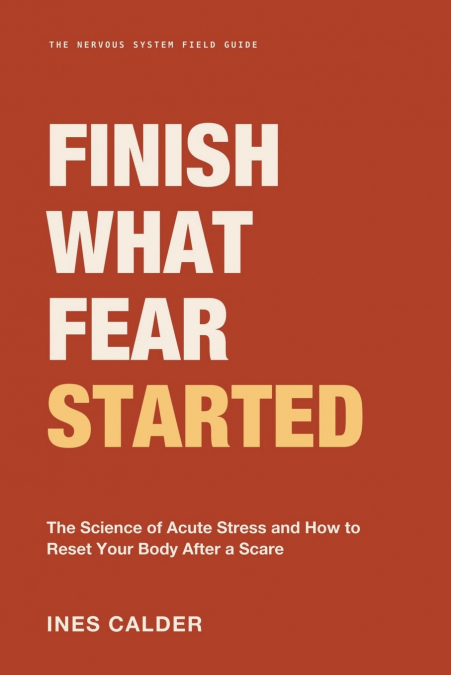
Ines Calder
The shaking hands ten minutes after the near-miss aren’t a malfunction-they’re your body trying to finish acycle you interrupted by going straight back to normal, and most of what determines whether you carry thatactivation for hours or release it in minutes depends on whether you know how to let the response complete.Part of The Nervous System Field Guide, Ines Calder’s insightful book explores the acute fear response and whyit so often outlasts the danger that triggered it.When a genuine threat appears-a car drifting into your lane, footsteps in an empty garage, a doctor’s pausemid-sentence-your body mobilizes in under two seconds, long before conscious thought catches up. Fear isnot anxiety’s vague, future-oriented cousin; it’s sharp, object-focused, and designed to resolve once the threatpasses. Finish What Fear Started is not an anxiety workbook, a meditation guide, or a general stress-reductionprogram. Instead, it maps the specific physiological signature of acute fear and teaches you how to complete thedefensive response your body began, so the activation doesn’t linger as free-floating unease.Through scenarios drawn from how fear actually unfolds in ordinary life, you will explore the mechanics ofincomplete threat responses:- The Signature: The one-and-a-half-second window before conscious thought arrives, when breathcatches, chest locks, and legs quietly load weight in preparation for movement you may never take.- The Unfinished Swerve: Why your hands keep shaking in an empty parking lot after the danger haspassed, and what your annoyance at that reaction misunderstands about discharge.- The Exam Room Bind: The cruelty of a fear response triggered by a clinician’s half-beat pause, when thesetting prohibits any physical outlet and...