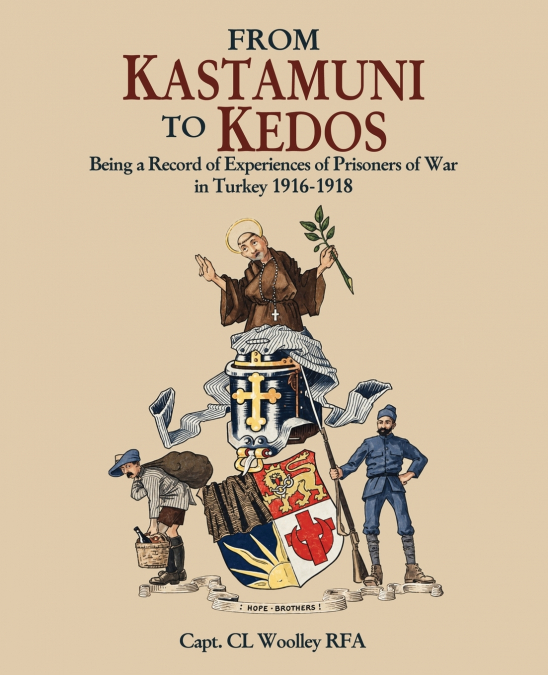
Capt. CL Woolley RFA
The narrative documents the material hardships endured by prisoners, including inadequate food, disease, forced marches, and uncertain living conditions, while also examining the relationships that developed between prisoners, Ottoman officials, guards, and local civilians. Woolley’s observations extend beyond personal recollection, offering valuable insights into Ottoman administrative practices, cultural norms, and attitudes towards Allied captives. Although his account is inevitably shaped by the perspective and prejudices of a British officer writing in the immediate post-war period, it remains a good source for understanding the lived experience of captivity and the complexities of intercultural encounters during the conflict.Organised chronologically, the memoir follows Woolley from his capture through successive transfers between prison camps to his eventual repatriation to Britain. Its combination of eyewitness testimony, descriptive detail, and critical reflection makes it a significant contribution to the historiography of the First World War. As both a personal narrative and a historical document, the memoir provides an invaluable perspective on resilience, survival, and the often-overlooked experiences of prisoners of war in the Ottoman theatre.ABOUT THE AUTHORThe renowned British archaeologist Charles Leonard Woolley was born on April 17, 1880. An Oxford graduate, he became assistant keeper in in the Department of Antiquities at the Ashmolean Museum in 1905. Best known for his excavations of the earliest Mesopotamian civilizations, Woolley began his archaeological career in 1907 when he joined a University of Pennsylvania expedition to excavate at Karanog and Buhen in Nubia. The same year, the British Museum selected him to succeed D.G. Hogarth as Director of Excavations at the ancient Hittite city of Carchemish along the present-day Turkish-Syrian border. Accompanying Woolley in Carchemish was T.E. Lawrence, better known as 'Lawrence of Arabia.' Woolley then worked at Tell el-Amarna, capital of the Egyptian king Akhenaton. In addition, his discovery of geological evidence of a great flood suggested a possible correlation with the deluge described in the Bible’s book of Genesis.Woolley and Lawrence entered the British Army in the fall of 1914. Woolley was commissioned into the Intelligence Service in Egypt. In 1916 a ship on which he was sailing hit a mine and sunk; Woolley was rescued by a Turkish vessel and made a prisoner of war. He was not released by his captors until the end of 1918. In 1919 he was ordered back to Syria as a Political Officer with the joint Anglo-French occupation.