zayed
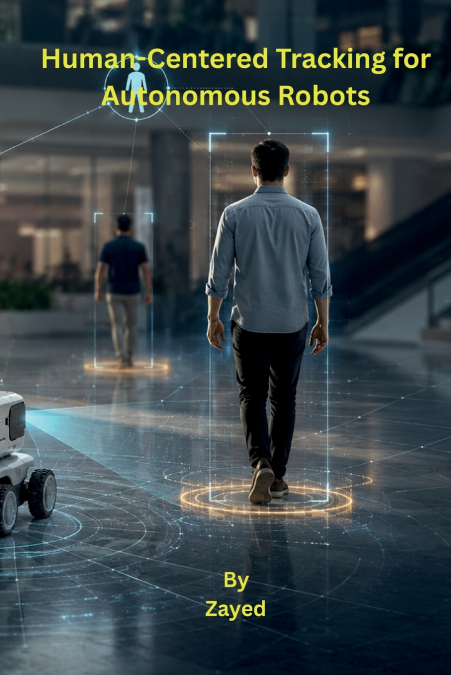
Human-centered robotics has become an essential area of research and development as autonomous systems are increasingly deployed in environments where they interact directly with people. Human-Centered Tracking for Autonomous Robots provides a comprehensive introduction to the principles, technologies, and engineering methods that enable robots to detect, identify, monitor, and safely track human movement in dynamic environments. By integrating robotics, artificial intelligence, computer vision, sensor technologies, and autonomous navigation, the book presents the core concepts that support reliable human-aware robotic operation across industrial, commercial, healthcare, and service applications.The book explores the foundations of human-centered tracking by examining how autonomous robots perceive and interpret human behavior using a combination of cameras, LiDAR, radar, depth sensors, inertial measurement systems, and other sensing technologies. Readers are introduced to the principles of perception, environmental awareness, object detection, feature extraction, target localization, and motion estimation that form the basis of intelligent tracking systems. The discussion emphasizes the importance of accurate perception in enabling robots to operate safely while maintaining effective interaction with people in complex and continuously changing environments.A significant focus is placed on tracking algorithms and autonomous decision-making techniques that allow robots to maintain awareness of human position, movement, and activity. The text introduces concepts related to computer vision, machine learning, sensor fusion, probabilistic estimation, multi-object tracking, trajectory prediction, and adaptive navigation. It also examines how perception and tracking systems contribute to obstacle avoidance, path planning, motion control, and collaborative robotics, helping readers understand the integration of multiple engineering disciplines within intelligent robotic platforms.The book further discusses human-robot interaction from both technical and operational perspectives. Topics such as safety-aware navigation, collaborative workspaces, real-time localization, environmental mapping, simultaneous localization and mapping (SLAM), behavioral prediction, autonomous decision support, and robotic situational awareness are presented within the broader context of intelligent automation. These discussions demonstrate how effective human tracking improves navigation efficiency, operational safety, task coordination, and user acceptance across a wide range of robotic applications.Designed for undergraduate and graduate students, researchers, robotics engineers, computer vision specialists, automation professionals, educators, and technology practitioners, this volume serves as both an academic reference and a practical introduction to modern human-aware robotics. The material emphasizes established engineering principles and broadly applicable methodologies rather than proprietary software platforms or vendor-specific technologies, making it relevant across research, education, and industrial environments.As autonomous robots continue to expand into healthcare, logistics, manufacturing, hospitality, security, smart cities, and public service applications, the ability to accurately detect and track human activity has become a critical requirement for safe and effective deployment. Human-Centered Tracking for Autonomous Robots provides readers with a structured understanding of the engineering principles that support reliable human tracking, intelligent perception, and autonomous navigation.