Scotty Brown
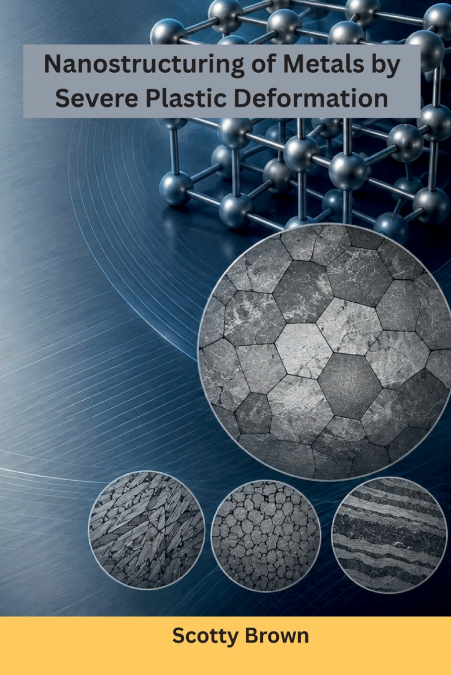
The development of ultrafine-grained and nanostructured metals is an important area of modern materials engineering because controlled microstructural refinement can significantly influence mechanical behavior, physical properties, and processing performance. Nanostructuring of Metals by Severe Plastic Deformation provides a focused introduction to the principles, mechanisms, processing techniques, and characterization methods associated with severe plastic deformation (SPD) for producing refined metallic structures. The book connects physical metallurgy, materials processing, metal forming, nanostructured materials, and mechanical engineering within a structured technical framework.The book introduces the relationship between plastic deformation and metallic microstructure, establishing the foundations needed to understand grain refinement at large plastic strains. Readers are introduced to crystallographic structure, grain boundaries, dislocations, lattice defects, strain accumulation, recovery, recrystallization, and texture evolution. These concepts explain how deformation can progressively modify the internal structure of metals and produce ultrafine-grained or nanostructured conditions.A central focus is placed on severe plastic deformation as an advanced approach to microstructural engineering. The text discusses established processing methods including equal-channel angular pressing, high-pressure torsion, accumulative roll bonding, and related deformation techniques. Attention is given to processing parameters, strain development, deformation routes, material flow, and the mechanisms responsible for grain refinement. The discussion provides a foundation for understanding how different SPD approaches influence the resulting microstructure.The book further examines the relationship between refined microstructure and engineering properties. Topics such as grain size, dislocation density, hardness, strength, ductility, fatigue behavior, thermal stability, and deformation mechanisms are considered within the broader context of ultrafine-grained and nanostructured metals. Readers gain an understanding of how microstructural refinement can affect mechanical response and why processing conditions are important when designing advanced metallic materials.Materials characterization is also considered an essential component of severe plastic deformation studies. The text introduces general approaches for evaluating grain morphology, crystallographic structure, phase characteristics, microstructural evolution, hardness, and mechanical performance. These concepts help readers connect processing history with measurable changes in material structure and properties.Important processing considerations are also discussed, including strain homogeneity, work hardening, recovery, recrystallization, thermal effects, microstructural stability, and the practical challenges associated with processing heavily deformed materials. Understanding these factors is important for evaluating the capabilities and limitations of SPD-based nanostructuring and for considering its relevance to advanced materials manufacturing.