Hafez Selim
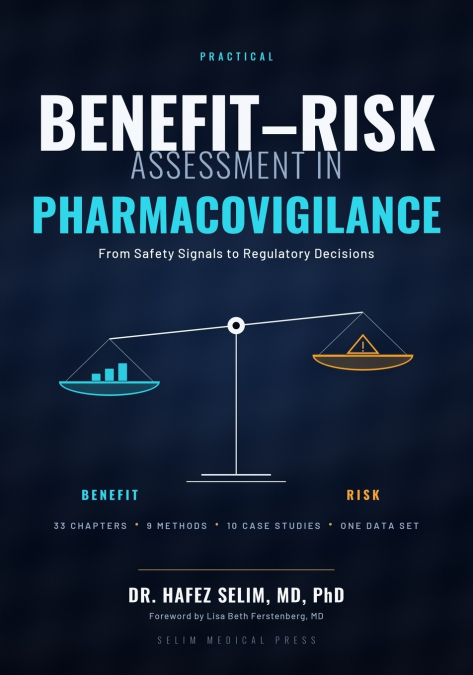
Every periodic safety report ends with one sentence: the benefit-risk balance of the product remains favourable. This book is about how to earn it.Practical Benefit-Risk Assessment in Pharmacovigilance answers the question that guidance documents leave open: you have the efficacy and safety data, so how do you actually decide? Across 33 chapters in seven parts, it follows the reasoning from a safety signal, through the structured qualitative frameworks, into quantitative analysis, and on to the regulatory documents where the conclusion has to be written down and defended.Part I sets out the concepts, evidence sources and uncertainty that underlie every assessment. Part II covers the frameworks regulators expect: the FDA Benefit-Risk Framework, the EMA effects table, PrOACT-URL and BRAT. Part III turns to quantitative methods - number needed to treat and number needed to harm, incremental net benefit, multi-criteria decision analysis with swing weighting, one-way and probabilistic sensitivity analysis, and Bayesian approaches. Part IV applies them across the product lifecycle, from first signal evaluation to periodic benefit-risk evaluation reports, risk management plans, development safety update reports and label changes. Later parts address special populations, communication, governance and the failure modes that recur in real assessments.One fictional medicine, Therapex, runs through the whole book. Every method is applied to the same dataset and the same clinical question, so the reader can see where two methods agree, where they diverge, and why. Each method chapter follows the same spine: the concept, the mathematics, a worked example, how to present the result, how to interpret it, its limitations, when to use it, and how to communicate it to a committee or a regulator.The book includes ten worked case studies, twenty-eight figures, four appendices of reference material and wording templates, and an interactive companion workbench that reproduces the calculators used in the text.It is grounded in CIOMS Working Group XII, ICH E2C(R2) and ICH E22, the FDA benefit-risk guidance, the EMA good pharmacovigilance practice modules, the IMI PROTECT roadmap and ISPOR good practices for quantitative benefit-risk assessment, and it is written by a physician-scientist whose career spans drug safety, clinical development and medical device regulation.Written for safety physicians, pharmacovigilance scientists, regulatory affairs and clinical development professionals, benefit-risk and epidemiology groups, and graduate students in pharmacoepidemiology and regulatory science.Foreword by Lisa Beth Ferstenberg, MD.