Practice to Mastery

Practice to Mastery

Jiazheng Chen

79,87 €
IVA incluido
Disponible
Editorial:
Jiazheng Chen
Año de edición:
2026
Materia
Población y demografía
ISBN:
9798907420830
79,87 €
IVA incluido
Disponible
Añadir a favoritos

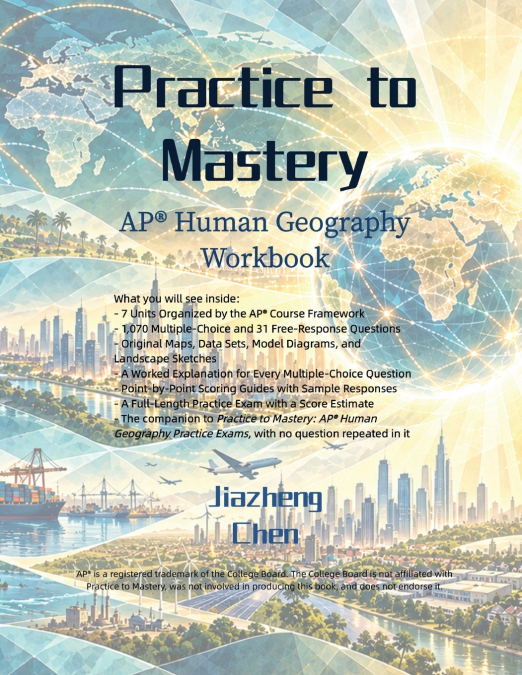
Practice to Mastery: AP® Human Geography Workbook is a question-by-question workbook for students preparing for the AP® Human Geography Exam. It holds 1,101 original questions: 1,070 multiple-choice questions and 31 free-response questions, organized by the seven units of the course and closing with a full-length practice exam.Human geography is learned by applying it. Knowing the definition of distance decay, the demographic transition model, or the bid-rent curve is only the start. The exam asks you to read a map you have never seen, interpret a population pyramid, explain a pattern at one scale and then at another, and decide which model fits a place and why. Every unit is written to train exactly those moves.Within each unit, the questions are arranged in three labeled tiers, Easy, Medium, and Hard, so you can build from the core vocabulary to the reasoning the exam rewards:Unit 1: Maps, Data, and the Lens of ScaleUnit 2: People in Place and in MotionUnit 3: How Culture TravelsUnit 4: States, Borders, and PowerUnit 5: Fields, Farms, and Food SystemsUnit 6: The Shape and Pull of CitiesUnit 7: Factories, Trade, and the Development GapAbout a third of the multiple-choice questions come in stimulus sets of two to four questions built on a shared map, data table, graph, model diagram, or landscape sketch, the way the real exam presents them. Every map and figure in the book was drawn for it, and the places in the data-based questions are invented so that each question tests reasoning rather than memory of a particular atlas. Every key geographic model in the course appears in its own reading questions, including the demographic transition and epidemiological transition models, population pyramids, von Thünen land use, central place theory, the concentric zone, sector, and multiple nuclei models, the Latin American and African city models, bid-rent, rank-size, Weber’s least-cost theory, Rostow’s stages, and world-system theory.Every unit includes four free-response questions in the current exam format: seven points each, parts A through G, rising from Identify to Describe to Explain, with one question without a stimulus, two with one stimulus, and one with two. Every free-response question includes at least one part that asks you to analyze relationships across geographic scales, and many draw on more than one unit. The scoring guide for each lists the point for every part, examples of acceptable responses, and scoring notes, followed by a complete sample response that earns all seven points.The multiple-choice explanations are written to teach. Instead of dismissing the wrong answers one by one, each explanation shows why the correct answer is correct: the concept, the model, or the reading of the map or data that settles the question. That is the reasoning you need to carry into the exam, and reading it after every question, right or wrong, is how the patterns stick.The book ends with a complete practice exam: 60 multiple-choice questions and 3 free-response questions in the format and timing of the real exam, with an answer key that labels the unit of every question, full explanations, scoring guides, and a guide to estimating your score.Every question, answer choice, map, figure, and explanation in this book is original. Content is assigned to units according to the published course framework, and terms outside the course are kept out of the questions.The companion volume, Practice to Mastery: AP® Human Geography Practice Exams, provides twelve more full-length exams with no question repeated from this workbook.AP® and Advanced Placement® are registered trademarks of the College Board, which was not involved in the production of, and does not endorse, this product.


Artículos relacionados

  • The Nature of Demography
    Hervé Le Bras
    Rapid changes over the last twenty years have impacted every branch of demographic analysis, from birth rates and immigration, to marriage rates and aging. The Nature of Demography is a response to these enormous changes. Written by one of the world’s leading demographers, this authoritative text offers a systematic and coherent overview of the fundamental ideas governing the s...
    Disponible

    109,19 €

  • Interaction Ritual Chains
    Randall Collins
    Sex, smoking, and social stratification are three very different social phenomena. And yet, argues sociologist Randall Collins, they and much else in our social lives are driven by a common force: interaction rituals. Interaction Ritual Chains is a major work of sociological theory that attempts to develop a 'radical microsociology.' It proposes that successful rituals create s...
    Disponible

    55,95 €

  • Migration, Mobility and Multiple Affiliations
    ...
  • Finding Strength in Numbers
    Alan Blackshaw
    A topical exploration of how communities can help heal trauma in individuals and groupsThere are many books dedicated to trauma. What sets ’Finding Strength in Numbers’ apart from these books is that it is one of the very few, or even the first, focussing on trauma and its relationship to community as the place where we heal. Trauma is a common human experience. Almost all of u...
    Disponible

    18,45 €

  • India Population Report
    ...
  • Death and the Metropolis
    John Landers
    ...
    Disponible

    52,36 €

Otros libros del autor

  • Practice to Mastery
    Jiazheng Chen
    Many students who score a 3 or a 4 on the AP® U.S. Government and Politics Exam already know enough government to score higher. They lose points on the free-response section because they name a concept instead of describing it, ignore the scenario, misread a chart, mix up two cases, or write an essay whose evidence never connects to its claim. This book shows exactly where thos...
  • Practice to Mastery
    Jiazheng Chen
    The free-response section of the AP® Microeconomics exam rewards precise work: a graph labeled the way readers expect, a calculation with its setup shown, an explanation that names the curve that moves and the rule that decides. Students who understand the economics still lose points when one of those pieces is missing. This book teaches each kind of point directly and then giv...
  • Practice to Mastery
    Jiazheng Chen
    You probably know more geography than your free-response score shows. Most lost points on the AP® Human Geography Exam come from answering a slightly different question than the one asked: describing when the prompt said explain, using one map when it said both, writing about the wrong region or the wrong scale, or stopping one step before the effect. This book shows you exactl...
  • Practice to Mastery
    Jiazheng Chen
    Most students who lose points on the AP® Psychology free-response section know enough psychology. They lose points because they don’t know exactly what readers reward: a design feature named when the question asked for a research method, statistics reported but not interpreted, an ethical guideline the study never mentioned, evidence repeated instead of explained, or the same c...
  • Practice to Mastery
    Jiazheng Chen
    Most students who score a 3 or a 4 on the AP® Comparative Government and Politics Exam already know enough about the six course countries to score higher. What they lack is a precise picture of what readers reward, and practice writing for that picture under time pressure. This book supplies both.Practice to Mastery: Decoding AP® Comparative Government and Politics Free Respons...
  • Practice to Mastery
    Jiazheng Chen
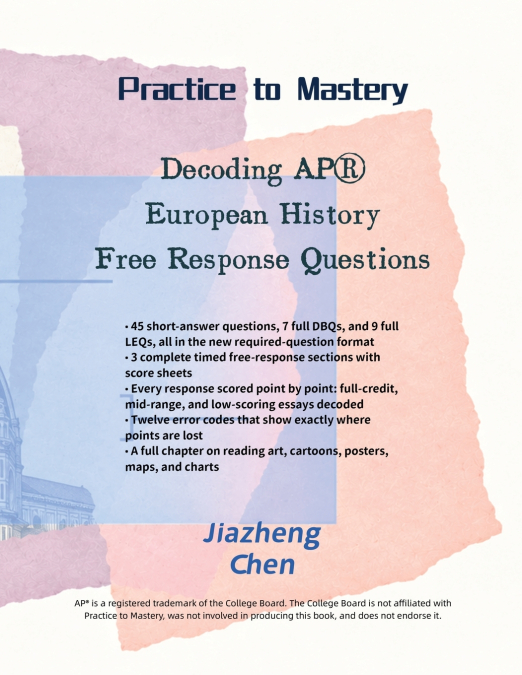
    Most students who earn a 3 or a 4 on the AP® European History Exam already know enough history to score higher. What costs them points on the free-response section is not missing knowledge. It is the gap between what they write and what readers actually reward: a description where the question asked for a purpose, evidence from outside the time window, a document summarized ins...
    Disponible

    82,53 €