Naim Tahir Baig
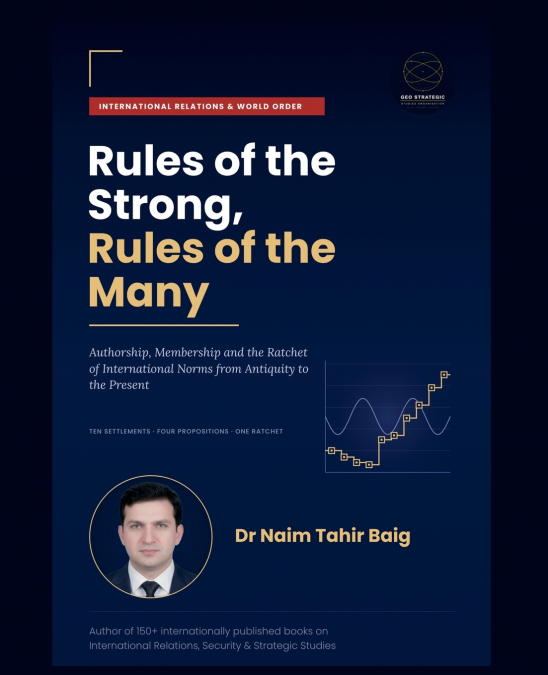
Rules of the Strong, Rules of the ManyAuthorship, Membership and the Ratchet of International Norms from Antiquity to the PresentBy Dr Naim Tahir BaigWho writes the rules of international order, and who do those rules protect? Rules of the Strong, Rules of the Many argues that international norms move in two rhythms at once. Authorship, meaning who writes and interprets the rules, oscillates: it narrows when a hegemon consolidates and widens when excluded actors force renegotiation. Membership, meaning whom the rules cover, ratchets: after each crisis it settles at or above its earlier boundary.Orders break down, Dr Naim Tahir Baig argues, when membership outruns authorship, a mismatch the book calls the authorship gap. The result is a cycle that never returns to its starting point. The ratchet is not a story of automatic progress. It holds only when excluded actors can make their exclusion costly for the core, and the book treats the collapse of Rome, the breakup of the Chinggisid order and the 1930s as tests of that condition, not as exceptions to be explained away.The argument is set against three rival answers: realist continuity, liberal and constructivist rupture, and the pure cycle of power-transition theory. It is tested on ten settlements chosen in advance, from Roman hegemony in the Hellenistic world and the Qin-Han unification through Westphalia, Vienna, Paris, San Francisco and decolonisation to the post-Cold War order. Each is coded the same way for authorship, membership and enforcement across five domains: use of force, sovereignty and recognition, diplomacy, human dignity and economic exchange.Four testable propositions anchor every empirical chapter, each closing with a Propositions check that reports where the evidence supports, qualifies or undercuts the thesis. The book states in advance what would count as failure, and it reports disconfirming cases openly.Written as a research monograph that advanced undergraduates and graduate students can read, the book offers scholars of international relations, the English School, international history and postcolonial thought a single framework for understanding why norms widen, narrow and widen again.