Sandeep Chavan
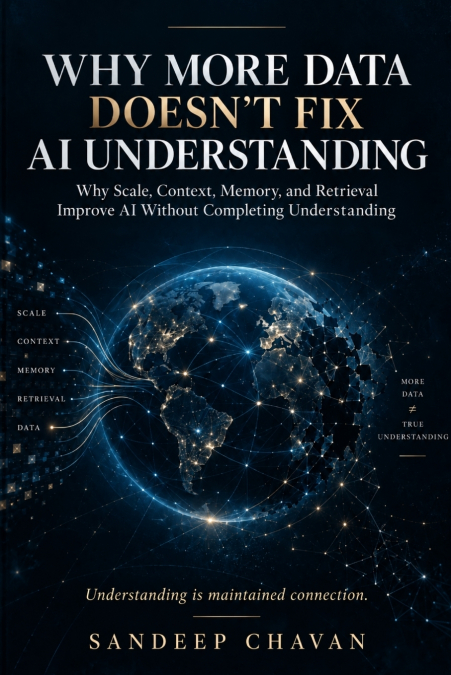
Artificial intelligence has advanced through more data, larger models, longer context windows, stronger retrieval, persistent memory, multimodal input, synthetic data, and increasingly powerful computation.But does having more information mean understanding more deeply?Why More Data Doesn’t Fix AI Understanding examines the boundary between information access and genuine understanding.Sandeep Chavan begins with a simple but consequential distinction: data gives an artificial system more differences to represent, compare, compress, retrieve, and predict. Understanding requires something further-the ability to preserve and revise the relations that keep those representations answerable to the field they concern.The book defines understanding operationally as:the capacity to preserve and revise the relations necessary for a representation to remain meaningfully constrained by the field it concerns.Across sixteen chapters, the book examines why several achievements commonly associated with advanced AI should not automatically be treated as proof of understanding.More data improves coverage-but coverage is not comprehension.Representation is powerful-but representation is not the thing represented.Compression creates usable abstraction-but it can remove the difference that later changes consequence.Similarity supports retrieval and generalization-but similarity is not identity.Longer context makes more information available-but context is not connection.Prediction can become highly accurate-but prediction is not necessarily explanation.Multimodality expands contact with the world-but multiple modalities do not automatically form unified understanding.Retrieval supplies sources-but sources do not make judgment.Memory preserves information-but preservation is not integration.Synthetic data expands available examples-but recursive generation can also create self-confirming informational loops.The book does not argue that artificial intelligence understands nothing, nor that machines can never understand. Instead, it asks what must remain connected before the word understanding is deserved. The final chapters develop the idea of maintained relation and the Missing Connection Circuit:world → measurement → data → representation → inference → action → consequence → correctionUnderstanding becomes increasingly credible when evidence can constrain representation, intervention can test explanation, consequences can return, contradictions can reopen conclusions, and correction can revise the relation that produced the error. Written for AI users, researchers, educators, developers, professionals, policymakers, and readers interested in machine intelligence, cognition, reasoning, representation, causality, retrieval, and AI reliability, this book offers a disciplined alternative to both AI hype and AI denial.The question is no longer simply whether an AI system has seen enough.The deeper question is:Does what it has seen remain connected to what it means? 6