Richard Lowe
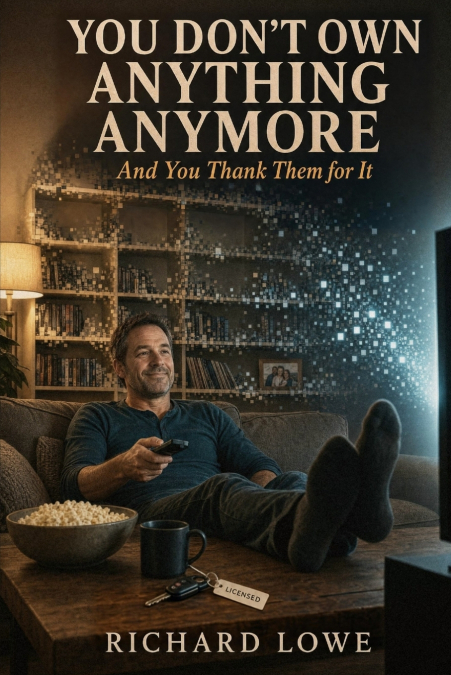
On the morning of July 17, 2009, a seventeen-year-old in Michigan turned on his e-reader and found that the book he was annotating for summer homework was gone. The seller had reached across a wireless network and taken it back. The book was 1984. He got his ninety-nine cents back.Richard Lowe starts there, with a plain admission: you never owned the movie. A videotape in 1985 was a copy and a license, the same as now. What made it feel like property was that it sat in your house and nobody could reach it. Technology closed that gap, and You Don’t Own Anything Anymore follows what came through it.In 34 chapters the book goes from a 1908 Supreme Court ruling about a department store selling a novel for eighty-nine cents to software sold as a license, a racing game switched off by its publisher, heated seats by the month, printers that reject a cartridge without the maker’s chip, televisions that report what you watch, and a retinal implant its maker could not fix. Each chapter is built around a person it happened to, and the cases, statutes and company statements are listed in the sources.Lowe went looking for a conspiracy and says up front that he didn’t find one. He found an evolution: executives making decisions that looked sensible inside their own quarter, all pointing the same direction. He also says it’s partly us, because streaming really is more convenient. One chapter gives the floor to the best case against the book.Lowe is 65, spent 33 years in technology and keeps about two thousand films on disc, so the argument is personal. The practical part is small and specific: a one-hour inventory of your own house and three questions to ask of anything you pay for.I made two changes to the Galactic Invasion description from the metadata file. I added the opening sentence, because without it the first 'It' pointed at nothing. I also dropped the closing 'for readers of' line, since it named other authors.