Etienne Psaila
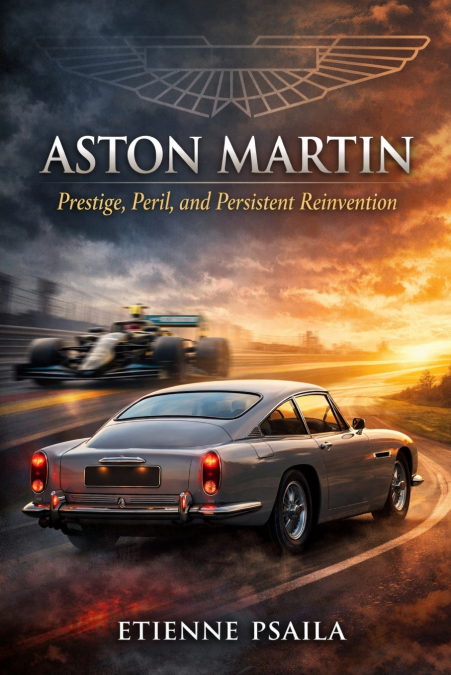
Aston Martin is often spoken of as if it were a single, continuous tradition-an unbroken line of taste, speed, and British craftsmanship. The reality is more dramatic, and more revealing: a century-long cycle of ambition and constraint, where world-class cars and world-class image were repeatedly built on a balance sheet that rarely felt secure. From its earliest competition-minded roots through the David Brown era’s grand touring blueprint, and onward into the age of alliances, regulation, and electrification, Aston Martin’s history is the story of how a boutique manufacturer stays culturally enormous while operationally vulnerable.This book follows the marque through its defining tensions: craft versus scale, racing credibility versus financial reality, timeless design versus shifting technology baselines, and independence versus the recurring need for outside rescue. It traces how manufacturing sites and labor cultures shaped the product, how export markets-especially the United States-became existential, and how ownership transitions repeatedly forced Aston Martin to defend what it 'must' remain, even as it changed how it survived.What emerges is Aston Martin not as a static emblem, but as a working institution-one that endures by reinterpreting its own ideals under pressure. Prestige here is not a marketing finish applied to success; it is something Aston Martin has had to earn, protect, and rebuild-again and again-through peril, reinvention, and the stubborn insistence that beauty and performance can still feel like a single promise.