MD Ishikawa Fujimoto
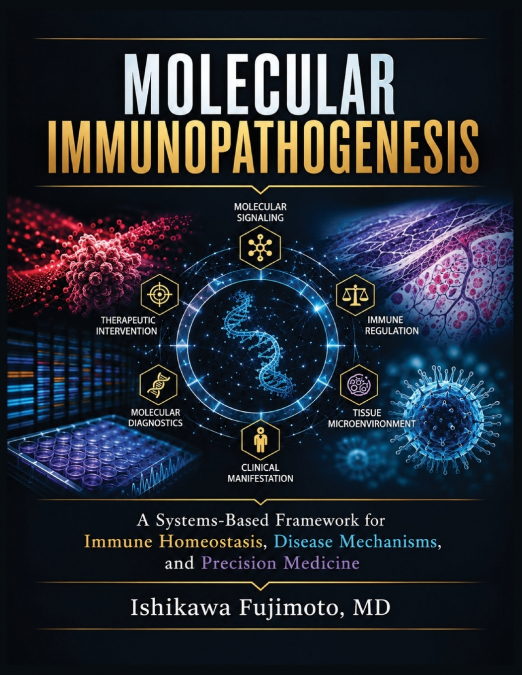
Immune-mediated disease rarely begins at the level at which it is diagnosed. A clinical phenotype is the visible consequence of disturbances that may begin with altered gene regulation, aberrant signaling, defective tolerance, metabolic stress, or disrupted communication between immune and tissue networks. Understanding those connections is central to understanding immunopathogenesis.Molecular Immunopathogenesis: A Systems-Based Framework for Immune Homeostasis, Disease Mechanisms, and Translational Precision Medicine develops this perspective systematically. It treats immune-mediated disease not as a collection of unrelated disorders, but as the consequence of disturbed biological networks operating across molecular, cellular, tissue, and organ-system levels.The framework begins with the architecture of immune homeostasis: how gene expression, epigenetic regulation, intracellular signaling, cellular metabolism, immune-cell interactions, tissue niches, and tolerance mechanisms maintain functional stability. From this foundation, the book examines how these regulatory systems become progressively destabilized and how that disruption generates persistent inflammation, altered immune recognition, tissue injury, and disease.This systems perspective provides a common mechanistic language for understanding autoimmune disease, autoinflammatory disorders, hypersensitivity, immunodeficiency, infection, and cancer. It also clarifies why clinically similar diseases can arise through different molecular pathways, why biologically distinct diseases can converge on similar phenotypes, and why patients carrying the same diagnostic label may respond differently to therapy.The book then follows immunopathogenesis into modern clinical translation. Molecular biomarkers, flow cytometry, sequencing, spatial biology, multi-omics, molecular classification, pharmacogenomics, targeted biologics, cellular therapies, gene editing, and RNA therapeutics are examined not as isolated technologies, but as tools for identifying and manipulating the biological networks underlying disease.The result is a mechanism-centered account of immunology that connects molecular disturbance to cellular dysfunction, tissue pathology, clinical phenotype, diagnostic interpretation, and therapeutic selection. Rather than emphasizing memorization of individual diseases or pathways, the book develops a framework for recognizing how immune systems fail, how those failures propagate across biological scales, and how they can increasingly be measured and therapeutically redirected.Written for medical students and biomedical scientists, with particular value for immunologists and clinical researchers, Molecular Immunopathogenesis provides an advanced but focused foundation for understanding contemporary immune-mediated disease and the transition from conventional diagnosis toward molecularly informed precision medicine.The central proposition is simple but consequential: disease phenotype is the downstream expression of disturbed immune networks. Precision medicine begins when those disturbances can be identified at their biological source.