Shane Larson
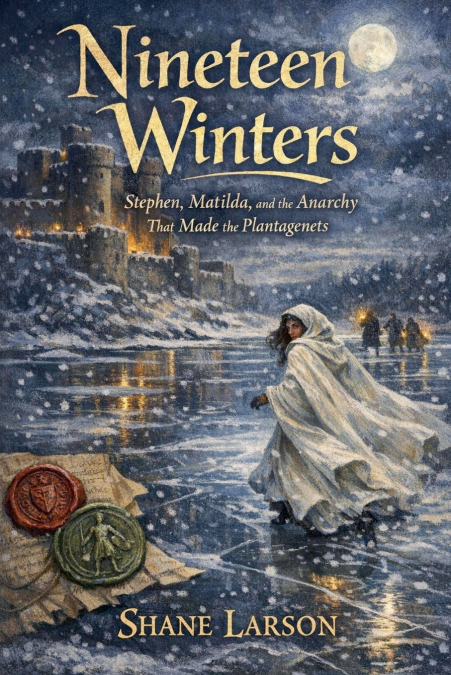
In June 1141 she held the King of England in chains, had been elected Lady of the English, and was at Westminster waiting to be crowned. Then the Londoners rang the bells, and she was out of the palace before dinner was finished.It began with a shipwreck. On 25 November 1120 the White Ship struck a rock leaving Barfleur with Henry I’s only legitimate son aboard and a crew the prince had been plying with wine. About three hundred drowned; a Rouen butcher survived. The king spent the rest of his life arranging for his daughter to succeed him. She had been crowned Queen of the Germans at eight and married to an emperor at twelve, and every baron and bishop in England swore to accept her, in 1127 and again in 1131. When Henry died in Normandy on 1 December 1135, his nephew Stephen of Blois crossed the Channel, took the treasury at Winchester, and was crowned at Westminster three weeks later. Almost every man who had sworn broke the oath inside a month.Nineteen years of war followed. A king captured at Lincoln fighting on foot with a broken axe. A bishop who changed sides three times. An empress who walked out of a besieged castle at Oxford and across the frozen Thames in white. A baron who turned Ramsey Abbey into a fortress and died excommunicate. And, running through all of it, two women with the same name: the Empress, fighting for a crown in her own right, and Stephen’s wife the Queen, who raised an army while her husband sat in chains, trapped the Empress’s forces at Winchester, captured her commander, and traded him for the king. The chroniclers praised one for a man’s courage and condemned the other for arrogance, for behaviour that looks, set side by side, remarkably alike.This is the whole war from both camps, told from the Latin chronicles with each writer’s bias named at every use, and tested against the evidence the chroniclers never saw: the tax roll of 1156 that maps the counties left waste, the coin hoards that show whose pennies circulated where, and the castles that can be counted. The Victorians called it the Anarchy. The record shows a kingdom with a hole in the middle, and the hole can be drawn on a map.What you’ll learn:Why an oath sworn twice by the whole baronage collapsed in a month, and why the answer is not simply that the heir was a womanHow Stephen won the crown in three weeks and lost control of the kingdom in four yearsWhat happened at Lincoln, Westminster, Winchester and Oxford between February 1141 and December 1142, as four chroniclers tell it differentlyWhy the Queen, not the Empress, was the most effective commander of the warHow anarchic the Anarchy really was: the chroniclers’ horrors against the writs, coins and castles, region by regionHow a medieval civil war ended in a treaty rather than a corpse, and why the Treaty of Winchester held when the Act of Accord of 1460 did notThis book is for you if:You have read novels set in Stephen’s England and want the history they were built onYou know 1066 and Henry II and want the missing fifty years between themYou read about women who held power before anyone had a word for itYou want the sources named, the disagreements shown, and the verdict left to youShe never wore the crown. Her son’s dynasty kept it for three hundred and thirty years.